Recently in Liturgy and Music Category

Clean sweep for papal liturgy advisors

| | Comments (0)

Here's a discreet but decisive change in Rome: Catholic News Agency reports that Pope Benedict has quietly dismissed all the former consultors to the Office of Liturgical Celebrations of the Supreme Pontiff, holdovers from the tenure of Abp. Piero Marini, and replaced them with supporters of the 'Benedictine' reform.

For English-speaking readers, the most familiar name will probably be Oratorian Fr. Uwe Michael Lang, author of "Turning Towards the Lord", recently appointed an official of the Congregation for Divine Worship and the Discipline of the Sacraments.

I'm going to have to start watching papal liturgies more closely!

What doesn't work

| | Comments (1)

One good thing we used to do at my old engineering job was to look for "Lessons Learned" when projects failed.

Today, a friend let me know that her efforts to put some really nice music into her father's funeral this week weren't going anywhere. The rest of her family overruled her. They didn't want the lovely Bainton motet or the Faure In paradisum. They didn't care about the plainchant Mass ordinary. They wanted "the Irish Blessing", "Be Not Afraid", and "Precious Lord, Take My Hand".

This effort reminds me about the value of a gradualist approach. People accustomed to OCP songs can't be expected to accept Latin plainchant and polyphony. We know that. I know that. I'm sorry I didn't say so up front. I could have told her, your suspicions are right, dear: this program is overreaching, so aim lower!

It reminds me of Dr. Mahrt's talk last year (mp3, 45 min.), in which he described turning his parish's music program around radically when they hired him; it took years, but he made many of the Church's musical ideals a reality, all without introducing Latin. Making the music of the Mass beautiful is more important than making the text Latin; and in fact, making it beautiful in the present is the pre-requisite to getting acceptance for Latin in the future. So beauty is what we need to focus on, and changes need to be introduced gradually.

For an average funeral, the best one can do may be just to steer the parish music staff to somewhat better, more beautiful choices than they would normally make; for example:
-- to use a dignified Mass setting (Proulx or Vermulst instead of Haugen)
-- to replace a bunch of musical-theater ditties with three or four sweet classic hymns (they can even be a bit cloying, but people will like them, and they're better than what they replace)
-- to sing a real responsorial psalm instead of a non-Scriptural song
-- putting the not-so-great songs that you're compelled to include before the Mass or after it

And when we're not making the final decisions, which is most of the time, we're forced to pray the famous prayer of AA and the other 12-step groups: "Lord, grant me the serenity to accept the things I cannot change...."

Dealing with a big family of siblings, my friend had nowhere near a free hand this week in her efforts. I had things easier when arranging for my mother's funeral a few years ago. Since she and I were both converts, there weren't any other Catholics in the family to interfere in the process! Even then, I couldn't get the parish music director to agree to all those items above. But some improvement was better than no improvement.

So when you have a chance to influence your parish in the direction of good music, be aware of what you really can't do yet; and do what you can!

The US bishops' conference Committee on Divine Worship is offering study materials on the new English-language Roman Missal texts, including a PDF file with the partial Mass Ordinary texts recently approved by Rome.

These translations are not coming to a parish near you any time soon, so there will be plenty of time to become familiar with them.

(Any composers want to get to work on musical settings? Go to it, and please do keep the Church's ideals and binding norms for liturgical music in mind.)

I sent a note to Fr. Z. today:

According to a press report, the new English Mass will say, "Lamb of God,
who takes away the sins..."

As far as I can tell, that's a grammar error, putting the verb "take" into
the third-person form, whereas the sentence is addressed to the second
person. It should be "who take", as in "you who take".

Is that press bit right, and do we need to ask CDWDS to head this bug off?

--rc

The reply:


Thanks for that!

I wrote to Card. Arinze about it.

Fr. Z

Quis custodiet custodes? Well, OK, I will. :-)

But this might just be an error on CWN's part. A WYD musical setting of the Mass used the new text approved in Australia, and it says, "Lamb of God, you take away the sins of the world...."

That's not ideal, as it doesn't follow the structure of the Latin clauses, but it would be better than having a grammar error ensconced in the official Mass text. I'd be gritting my teeth for decades if that were to happen.

We'll find out what the case is eventually.

A good start at the Cathedral

| | Comments (3)

In Boston, the traditional Latin Mass has moved from its former home at Holy Trinity Church to the Cathedral of the Holy Cross; today's celebration was a Low Mass in the lower church, and 101 souls attended, about as many as attended at Holy Trinity. Fr. Bernard Shea, SJ, has been a frequent celebrant of the old Mass. Holy Trinity's music director emeritus George Krim served as organist, and the chant choir Schola Amicorum sang.

For the anniversary of the announcement of Summorum Pontificum, we sang the Oremus pro Pontifice.

Don't do this in church (2)

| | Comments (1)

Just to prove that we Americans don't have all the bad taste in the world, here's an AP report about how the Aussies are just as able to choose bad funeral music:

Australians making odd choices for funeral songs

5 minutes ago

Hymns are being replaced at funerals in one Australian city by popular rock classics like Led Zeppelin's "Stairway to Heaven" and AC/DC's "Highway to Hell," a cemetery manager said Wednesday.

At Centennial Park, the largest cemetery and crematorium in the southern city of Adelaide, only two hymns still rank among its top 10 most popular funeral songs: "Amazing Grace" and "Abide With Me."

Leading the funeral chart is crooner Frank Sinatra's classic hit "My Way," followed by Louis Armstrong's version of "Wonderful World," a statement said.

The Led Zeppelin and AC/DC rock anthems rank outside the top 10, but have gained ground in recent years as more Australians give up traditional Christian hymns.

"Some of the more unusual songs we hear actually work very well within the service because they represent the person's character," Centennial Park chief executive Bryan Elliott said.

Among other less conventional choices were "Always Look on the Bright Side of Life" by the Monty Python comedy team, "Ding Dong the Witch is Dead," "Hit the Road Jack," "Another One Bites the Dust" and "I'll Sleep When I'm Dead."

The Pope's Mass in Washington

| | Comments (10)

When the Pope started the Mass at Nationals Park, he began it with the words: "In the name of the Father, and of the Son, and of the Holy Spirit."

This must have surprised many people who are used to hearing other greetings such as "Good morning, everyone," before or after the Trinitarian invocation. But the faithful attending did respond with, "And also with you," instead of "Good morning, father" or whatever. So it's good to know that we Catholics are at least a little teachable.

OK, now to liveblog, if not to say nitpick, the music of the Mass:

Kyrie eleison: the invocations were set to some black-gospel-inspired music, and came across as rather self-indulgent: they drew attention to the deacon's virtuosity. However, the "Kyrie eleison" responses were quite nice.

Gloria in excelsis Deo: The Gloria was accompanied by some handbells that didn't seem quite in harmony with each other. The text was chopped up artificially to give it a responsorial form. Here a pattern started to appear: apparently any old music was thought to be just fine, provided one slapped a few words of Latin on it. If the modern liturgists in charge of this production think they've solved the problems facing the contemporary music establishment with this tactic, they've got another think coming.

1st Reading: Acts, in Spanish. Is it really normative that a lay person not invested in the ministry of lector (lay women are not eligible for it) present the Scripture reading?

Responsorial Psalm: The music was a Broadway-style number, with weird dissonances in the setting of the verses and the refrain. It started out as laughable and ended as horrifying. Too bad that no-one was capable of singing the proper from the Roman Gradual, as the GIRM prefers.

2nd Reading: Romans 8: Another lay woman reading the Scripture, and reading it well enough. But what about diversity: is there some problem with lay men? Are they unacceptable?

Alleluia: a modern composition built on the refrain from O filii et filiae. This illustrates that even some antique hymns written in chant notation are not suitable for this sort of liturgical use. O filii et filiae is the Renaissance's equivalent of the Celtic Drinking Song Alleluia: a "rousing" number in triple meter. Let's all lock arms and sway, right? Um, let's not. It's not an ideal preparation for listening to the Holy Gospel.

The Homily was a wonderful word of encouragement to the faithful to be a faithful leaven in society. The Pope is not unaware that the Church here needs to accept the practice of penance and follow the way of holiness. We need to engage in sound catechesis, and Catholics need to "cultivate an intellectual culture that is truly Catholic", ringing the insight of Christian thought and judgment to society, lest we be merely conformed to the every vagary of the latter.

The General Intercessions were, as Fr. Neuhaus pointed out, a display of multiculturalism. Whom are we trying to impress in the General Intercessions?

The offertory music was a bit of Latino dance music performed with bongos and, I think, an ocarina or maybe a Peruvian flute. At the "breakdown" of the song, there was clapping. I don't think the Offertory proper was sung.

It was good to see the altar adorned with a crucifix and six candles in the arrangement that has come to be described as "Benedictine".

And then the most amazing thing happened. As Jeffrey Tucker has already commented on the NLM blog, Marty Haugen's setting, his Mass of Creation became a surprising moment of relative musical dignity.

There seemed to be no bells at the consecration, which is odd since there was plenty of handbell ringing during the Gloria.

The memorial acclamation was introduced by a fanfare of car horns, I believe, and they were used again for the Amen.

Now, at this point of the Mass, I stepped into my kitchen for a few minutes, so I missed the Our Father. Was it sung? I didn't notice it.

The Agnus Dei was another multi-culti display. Apparently singing the little litany in Latin plus several obscure languages to some strange music is better than singing it in Latin. The result was a piece that no one could reasonably use in any parish whatsoever.

The Communion selections included everything but the kitchen sink, except for the proper. One of them was a merengue number. One was the Cesar Franck Panis Angelicus, sung by Placido Domingo: the only piece of music in the entire Mass that visibly pleased the Holy Father.

So thanks be to God, the successor of Peter has come to strengthen us, to exhort us, and -- now that he has experienced the genius that is American-style liturgy at its ultimate -- he has come to suffer with us.

What we heard at Mass today

| | Comments (5)

Went to my suburban parish today for a Saturday 4 pm Mass. They had a pretty competent organist at the console today, which you can't usually count on at this church, so it was a good start.
Entrance Hymn: These Forty Days of Lent
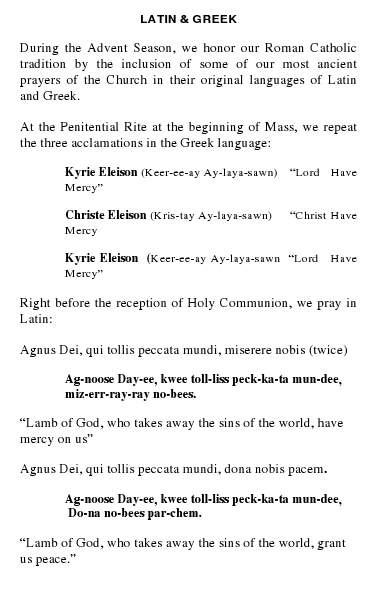
Kyrie: plainchant from the Missa Primitiva

These first two pieces were a good start too. Have I been too critical of the parish's music? Are things actually improving? Maybe I should be willing to volunteer here.

Responsorial Psalm setting: Psalm 23, some contemporary setting in 3/4 time.

It didn't sound bad, but the composer took liberties with the text: "You give me the courage I need". What? I wish they wouldn't do that.

Today was Appeal Sunday, so some teens who didn't know how to genuflect came into the sanctuary and maneuvered a projection screen in front of the tabernacle. We saw a video by the Cardinal. It contained a good homily, so I forgave the intrusion of technology. Then the teens put the screen aside again.

Things went downhill from there:

Offertory: Precious Lord, Take My Hand

It's a classic black gospel song written by the great Thomas Dorsey (see the documentary Say Amen, Somebody), but was it suitable for Mass? Nope, nope, nope: (1) it's a syncopated text setting, and that's enough to rule it out: an above-average choir can sing something this rhythmically irregular, but congregations can't, especially with the loose tempo they used; (2) the text is soloistic: all about the Lord Jesus and Me; (3) it's a black gospel song, sung in a practically all-white suburb, which is pretentious. For probably all of those reasons, nobody in the congregation sang along.

Then things got better again:

Holy: something reasonably good and singable: it sounded like Proulx
Amen: a matching piece
Agnus Dei: plainchant from the Missa Primitiva

And then we went back to Protestant sentimentality:

Communion: Softly and Tenderly, Jesus Is Calling

You know the one I mean? "Earnestly, tenderly, Jesus is calling, calling for you and for me" -- this time they decided to dip into the Baptist playbook and pull out this 1880 piece; another dramatic solo number, a little more bathetic than the previous one. Too bad the missalette publisher didn't respect the song's integrity, and took out the pointed expression: "O sinner, come home". Blah.

Second communion piece: The Old Rugged Cross (organ instrumental)

What's the deal here? Do these musicians think they're improving the Mass by pulling out this 1913 number? A lot of Catholic hymns from the period were kitschy music that doesn't belong in Mass, and -- guess what? -- so are a lot of the Protestant ones!

If the musicians in this parish wanted to bring in some Protestant music as an attempt at "inclusivity" or "inculturation", they should have noticed that we here in New England are not surrounded by revivalist tabernacles or black churches, so those songs don't reflect the local culture. They're a cultural pose. In contrast, New England has lots of congregations where you'll find Congregationalists, Methodists, and Episcopalians, and if only we'd stick to stealing their hymns, we'd have something much more singable!

Finally, as a relief, the music switched back to a perfectly acceptable hymn:

Recessional hymn: Lift High The Cross

The parish music is suffering from Multiple Personality Disorder.

OK, I admit it: there is a "Christmas carol" which I really, really don't like. I simply find "What child is this?" rather depressing. I think it's not the tune's association with Henry VIII (that robber and killer); it's the whiny "Greensleeves" tune itself.

The carol would have been more upbeat if the pop-band "Chicago" had sung it:

"Does anybody really know what Child this is?
Does anybody really care about this Child?
If so, I can't imagine who;
but He was born for me and you."

Verse 1:
"As I was walking through the town one day,
a man and woman came to me
and asked: is there an inn where we can stay
today?"

The Russian concert on EWTN

| | Comments (2)

For those who didn't hear the concert aired on EWTN Monday night from Washington, here's a link to other music by the same composer, the Russian Orthodox bishop Hilarion (Alfeyev).

I only heard about half of his Christmas Oratorio, but so far I like his liturgical music better. The latter is really quite beautiful, but the oratorio's long recitatives of Scripture texts, delivered ascetically stentorian and recto tono, didn't seem fitting in the work of a non-liturgical nature, intended for concert performance.

The premiere of a lengthy new work necessarily carries with it a certain amount of tension: when the composer is a bishop and the concert is hosted by another Church, add some more; this time, in a foreign capital, at a time of heightened international stress, this performance by the Orchestra and Chorus of the Russian Defense Ministry, of all things, came off as a joyless reminder of the Cold War. It's too bad: Bp. Hilarion deserves better.

What? Who?

On life and living in communion with the Catholic Church.


John Schultz


You write, we post
unless you state otherwise.

Pages

Powered by Movable Type 4.12

About this Archive

This page is a archive of recent entries in the Liturgy and Music category.

Language is the previous category.

Marriage & Family is the next category.

Find recent content on the main index or look in the archives to find all content.