Recently in Catechesis Category

Magisterium in a nutshell

| | Comments (0)

Cool!

Wikipedia's article on Magisterium has a neatly organized table listing the possible ways authoritative teaching is expressed in the Catholic Church, and showing what type of assent is required in each case. Infallible teaching is to be believed with an act of the virtue of faith; authoritative non-infallible teaching is to be accepted with "religious assent".

Keep this summary handy for when people ask you whether a particular document's teaching is infallible.

Does Mass on a Friday count towards a Sunday obligation?

| | Comments (3)

The answer to the question above is usually "no," but I think I may have found an exception. I have to travel to the Middle East this week, and because the work week is from Saturday to Wednesday, I will probably be working all day on Sunday. The country where I will be is part of the Vicariate Apostoic of Arabia, which apparently has a dispensation to allow Friday Masses to "count" as the Sunday obligation:

• On Fridays (mornings and evenings) and Saturdays (evenings only) the Holy Mass is that of the following Sunday.

Am I reading this correctly? This isn't the parish I would attend (I'm not going to Kuwait), but it's the cathedral parish of the vicariate -- can I assume that this dispensation extends beyond Kuwait to the other countries in its territory? I'll probably end up attending Mass on Sunday — there are plenty of Masses throughout the day in the parish I found — but it might be more convenient to attend on Friday.

This seemed like an interesting question, because I had never heard of such a dispensation. Servicemen deployed during wartime can attend Mass at any time during the week and have it fulfill their Sunday obligation, because they are not always able to attend for obvious reasons. These circumstances are quite different.

What rights are civil and what rights are natural?

| | Comments (0)

Here's is a political question with a natural law twist. I (and probably you) frequently read sentiments like this: "...of all rich countries the US has lost the most civil liberties recently. But I'm not too worried yet. I'm hoping once the present administration is out, the natural openness of American culture will reassert itself."

You can see the quotation in context here, but it doesn't matter that much. What interests me are two things:

1. The blatant exaggeration. In this case, the author doesn't bother to enumerate which civil liberties we have "lost" -- and people who write such things rarely do. They talk about wiretapping powers as if the Feds are listening to every phone call we make. But even if these measures are contrary to our rights, at best these are marginal encroachments: no one, to my knowledge, has abolished the right to free association.

2. The connection with natural law. Americans like to conflate natural rights (which are given by God) and civil rights (which are granted, or at least recognized, by temporal powers.) These are overlapping categories, certainly. The right to bear arms is connected with the natural right to self-defense. The right to property is explicit in both natural law and revealed scripture.

What about other civil rights? I do not consider voting to be a natural right, as it is possible to have a just government without elections or democracy. Free speech, at least as we constitute it today, does not seem to be a natural right, either. Those civil rights are good for our system of government, because they allow citizens to remove bad politicians and substitute good (or less bad) ones, and to speak out against their government's policies or actions and urge correction. But that does not make them part of natural law, as their objects -- the goods they serve -- are ordered toward right government and not man per se.

I am not arguing that any civil right should be curtailed or abolished, but it would help to distingush between them and the ones that are truly inalienable.

I haven't read it yet, but I'd like to dig into the Compendium of the Catechism of the Catholic Church. Ironically, the condensed version has a much longer title.

Jimmy Akin has read the Compendium, and likes it. I happen to like Jimmy Akin, as we once sat and smoked together in a San Diego tobacco store, so you can trust his judgment.

One reason I'm anxious to get my hands on this volume is so I'll have better answers for my kids when they ask questions. Explaining justification is quite easy. Explaining the Trinity is not.

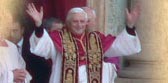
pope_benedict.jpg We here at Catholic Light are just as grateful as can be for the election of Pope Benedict XVI, and so are most of our readers.

Yet we cannot overlook the plight of readers who are disappointed or frustrated to find that this new Pope believes exactly the same faith as did Pope John Paul II. He believes the same as every other Pope before him, without subtraction or contradiction.

I do hope all these folks who are feeling frustrated today will come to accept what has happened, and understand that the outcome is nothing to be distressed or even surprised about: it's the completely normal result of a papal election.

We Catholics should have done a better job before the election to help our diverse friends on-line set their expectations. Start with this, because you can rely on it above all else: the Pope will be an orthodox Catholic, one who holds and teaches the established faith of the Church. If there are any points of Catholic teaching that you might consider erroneous, misguided, or just unpleasant, please understand that he will not change them. It's not his calling to do that, and he doesn't have the power to do it. In fact, we believe that the Holy Spirit will not let him do it.

That's because Christianity is a revealed religion -- that is: a religion bearing spiritual and moral teaching revealed by God, and of course divinely revealed doctrines are true, because God cannot lie; and if we were to change our acceptance of those, we'd be falling into error.

This is how the Church understands herself: on a mission from God, to bring all of mankind into friendship with Christ, to receive salvation and truth from Him: or at least to bring to Him as many of mankind who will accept Him.

I can't expect everyone to agree with the Church, but please do accept that this is our faith; this is who the Church is and what she's about. Don't be disappointed when the Church doesn't fulfill the wishful thinking of pundits who profess with great self-assurance that some future Pope will change Catholic teaching on morals. Don't expect the Church to fulfill even your own wishful thinking, if you want her doctrines to be reversed. The Church isn't here to be constantly changed by the world; rather, she is here to change the world.

My second post about self-sacrifice is about a little Iraqi girl who risked her life to save others (don't worry, there's a very happy ending.)

On a didactic note: this story shows the folly of consequentialism, an error propounded by some liberal theologians and explicitly condemned by the Holy Father in Veritatis Splendor. Consequentialism is the idea that you can only know if an action is truly good or bad according to the outcome of the action. But that's foolish because, since no one can know the ultimate outcome of any given action, there's no way you can accurately gauge its effect beforehand. Therefore, you should do good and hope that good comes of it.

As if to illustrate this principle, a small act of almsgiving led to a huge act of bravery. Seriously, read the story. I personally guarantee you won't regret it.

Why are my confessions so brief?

| | Comments (15)

I get the impression that my confessions are shorter than average. That is not because I sin less than other people. I try to go to confession at least once a month, and I rarely go more than six weeks without receiving the sacrament. (Grace is like gasoline to my soul: I run fine as long as I keep pouring it in regularly.)

At first, I thought I was just underestimating the time. "Time flies when you're recounting your offenses against God," as the saying goes. But a couple of weeks ago, I waited for more than an hour behind 10 people or so, and I couldn't have taken more than two minutes. This has happened with many different priests at several parishes, so I don't think I'm imagining it; even when the people in front of me are taking 5-10 minutes, I'm finished in half that time.

What's going on here? Usually, I think of my sins beforehand and rattle them off unless the confessor asks me for clarification. If there are some mitigating or exacerbating circumstances, I mention them. For example, a while ago I missed Mass through no fault of my own, but I felt relieved because I had a lot to do that evening. That was clearly not a mortal sin, but since I treated Mass that day as a chore, it showed how far I was from saintly perfection.

Do people try to get pastoral advice in the confessional? I take it if it's offered, but I don't ask for it unless I have a question about something I'm confessing. Or do a lot of people need on-the-fly catechesis, and priests try to teach the penitents that certain things are sinful? I have several spiritual shortcomings, but resistance to orthodox teachings isn't one of them.

I'm not fishing for someone to say "you're so holy, Eric," because I know that's not true. I'm truly curious.

What happens if you don't make an act of contrition?

| | Comments (11)

I went to the church nearest the Nameless Entity, in a blessed old urban parish run by the Dominicans. One of my Advent penances is to go to confession every week, and I thought I'd get started a week early.

This was the second time I had this particular Dominican. He is, I'm convinced, an entirely orthodox and kindly old man, with a genuine love for sinners and an evident joy for God's creation. However, both times he didn't ask me to make an act of contrition. The second time, I said one to myself as he gave me absolution.

I believe that this is a defect in the form of the confession itself, but the absolution is still valid. But what should I do when I have him next time? Charitably correct him? I'm uncomfortable with doing that — it doesn't seem very penitential. Maybe I should say, "Father, do you mind if I say my act of contrition?" I'm open to suggestions.

Bonus question: after I went to confession, I stayed for daily Mass, but I had finished eating lunch at around 11:45 and the Communion was at about 12:35 or 12:40. I abstained from the Eucharist because I had eaten less than an hour before, because I had not planned to attend Mass.

I think I did the correct thing, but is there any kind of exemption if you did not deliberately break the one-hour fast before receiving? I don't think there is, but I just thought I'd check to see if anyone knew.

Why should the bishops talk about gay marriage?

| | Comments (3)

In a comment on a previous post, I opined that Catholic bishops have been talking about homosexual marriage recently because homosexuals brought it up in the first place. Blaming them for taking an interest in the subject is sort of like blaming Poland for starting World War II.

I wanted to expand on my point that "militant homosexuals [are] trying to destroy marriage." On the surface, that would appear to be hyperbole -- they are merely trying to expand the definition of marriage, much as the definition of "citizen" has expanded to embrace blacks. It does not diminish American citizenship to let blacks have their full compliment of civil rights, goes the argument, so why is marriage injured by homosexual civil marriages?

Up until the campaign for gay marriage moved into its active phase in the 1990s, the homosexual movement agreed with the feminists: marriage is an essentially patriarchical, oppressive institution that codified the dominant heterosexual, masculine paridigm of American society. (Sorry for the jargon -- I'm trying to use the same terms they used when I was in college in the '90s.)

Now, however, the campaign for gay marriage has shifted its position, saying that homosexuals will be "civilized" (their word, not mine) by it, and therefore society will benefit because the instability of homosexual relationships will be greatly mitigated.

But you cannot radically redefine a concept without changing its essence. If marriage consists of one man and one woman, to change that formula is to make it something different. Even if you make the change for a greater good -- reducing the astonishing promiscuity of gay men, for example -- you will have mutated marriage into something else. Call it what you will, an agreement or a contract or even "marriage," but it will have ceased to be itself.

Supernaturally, marriage helps us because spouses assist each other in their journey toward heaven. Also, the relationship between husband and wife is a model of Christ and his bride, the Church. On the natural level, marriage is for begetting and rearing good children and thus the perpetuation of a good society.

The further we drift away from those fundamental ideas, the more the Church will insist upon the proper understanding of marriage. It's not rude of the bishops to indicate that homosexuals are trying to further degrade marriage in the popular mind, as well as civil law. It's their job, and may they do it well.

I have nothing but sympathy for those who have a homosexual orientation through no fault of their own. As a fellow sinner who lives with the residual yet powerful effects of original sin, I cannot imagine how difficult it must be to go through life with that burden, especially for people attempting to live a Christian life. Indeed, I am awed by their courage.

I hope that society can find some way to accomodate homosexuals without veering off to the extremes of violent rejection of their existence, or unqualified acceptance of homosexual conduct. However, defining marriage out of existence will not solve that problem.

I, for one, consider that with many men their faith has become uninteresting to them, because they have not grow out of the metaphor, the imagery of it, into a rational understanding. In everything else, their mind has become a man's mind; they have put away the things of a child. In matters of Faith alone, they still are bound to speak as a child, to understand as a child, with the result that Faith has become insipid to their virile minds.

From a book written in 1913, this short passage has much to say to about catachesis today.

What? Who?

On life and living in communion with the Catholic Church.


John Schultz


You write, we post
unless you state otherwise.

Pages

Powered by Movable Type 4.12

About this Archive

This page is a archive of recent entries in the Catechesis category.

Canonical is the previous category.

Controversies is the next category.

Find recent content on the main index or look in the archives to find all content.